
As patients and healthcare providers urgently seek new therapies to address unmet medical needs, the pressure to accelerate drug development has never been greater.
In a landscape where timely access to innovative treatments can profoundly impact patient outcomes, traditional development processes often struggle to keep pace with scientific and clinical demands.
In a traditional drug development model, formulation development and drug product manufacturing (CDMO) and clinical testing (CRO) are separate activities, often handled by different vendors and on different timelines. If not managed well, siloed activities performed by each of these vendors can cause inefficiencies that increase timelines and risk.
The separation of activities also introduces risk for early clinical studies, often resulting in using provisional formulations selected based on preclinical assumptions rather than emerging human data. For example, if clinical pharmacokinetics (PK) are inadequate, sponsors may need to redesign the formulation, repeat manufacturing, and re‑run studies. These factors not only cause delays that increase costs but result in data packages that lack clear translational value for decision making.
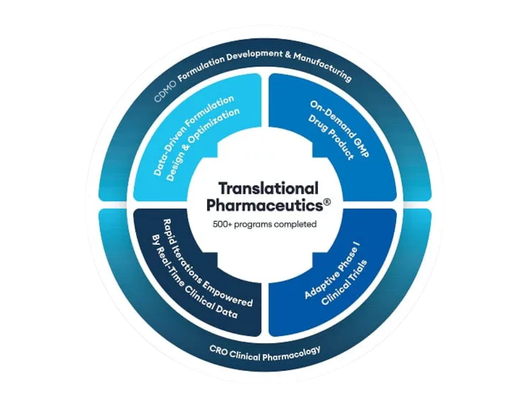
Quotient Sciences’ Translational Pharmaceutics® platform is a novel approach we introduced nearly two decades ago for innovating the way early clinical trials are designed and managed. Using Translational Pharmaceutics® allows sponsors to mitigate risks by integrating drug product formulation, cGMP manufacturing, and clinical testing into a single, adaptive workflow. Quotient Sciences performs all activities within its facilities, as an integrated CRDMO.
Translational Pharmaceutics® can be used for simple drug products, such as a blend or API in capsule, where it has been shown to accelerate first subject first dose in a first-in-human (FIH) study by four months or more; savings come from smaller batch sizes requiring shortened development timelines and limited stability requirements. When a drug is poorly soluble and requires an enhanced formulation to achieve adequate exposure, this platform allows phase-appropriate manufacturing and release of multiple formulations for direct testing in healthy volunteers or patients, which can be included in a FIH study.
After a drug has completed FIH and if shows suboptimal PK (e.g. due to a short T1/2 requiring twice a day dosing or Cmax related AEs), Translational Pharmaceutics® can be also used to assess multiple modified release formulations within a follow-up study. Formulation optimization can happen during the clinical study based on emerging clinical data by testing different drug product compositions, doses, and release rates within a defined “design space.” By adjusting these variables based on the latest clinical data, decisions are guided in real time, allowing for more flexible and informed development.
By eliminating organizational and operational boundaries that normally exist between CDMO and CRO activities, Translational Pharmaceutics® also removes transition steps and downtime -- which we often refer to as the “white space” -- and any costs incurred with additional formulation changes and clinical testing. Data-driven adjustments for formulation composition and dose exploration in real-time creates an ongoing feedback loop between manufacturing and the clinic during the study, without compromising testing rigor or participant safety.
As mentioned before, accelerated timelines do not mean reduced quality when it comes to safety standards. From a medical director’s perspective, participant safety is supported by maintaining rigorous clinical oversight while ensuring formulation decisions are directly informed by real time human data. In traditional development models, delays and disconnects between formulation teams and clinical teams can limit responsiveness to emerging safety signals. In contrast, the alignment between these activities that Translational Pharmaceutics® enables allows safety considerations to remain in focus, without compromising regulatory rigor or Good Clinical Practice.
As a result, sponsors gain earlier, more reliable clinical insight that helps them avoid late-stage reformulation, conserve valuable API, and reach proof-of-concept decisions faster and with greater confidence.
Juliet Vento, MD, is the Senior Medical Director at Quotient Sciences, based at the Company’s Miami, FL clinical pharmacology unit.
Learn more about our clinical pharmacology services.