


Over the last few years, proteolysis-targeting chimeras (PROTACs) have been gaining interest as powerful candidates for tackling proteins once considered beyond the reach of conventional small molecule therapies.
PROTACs can eliminate specific proteins by harnessing the cell’s natural degradation system. Since being discovered in 2001, with first breakthroughs in research happening between 2008 and 2015, more than 300 PROTACs are now part of global development pipelines. Main applications for PROTACs are focused on oncology (solid tumors), infectious diseases, autoimmune and neurodegenerative conditions (1).
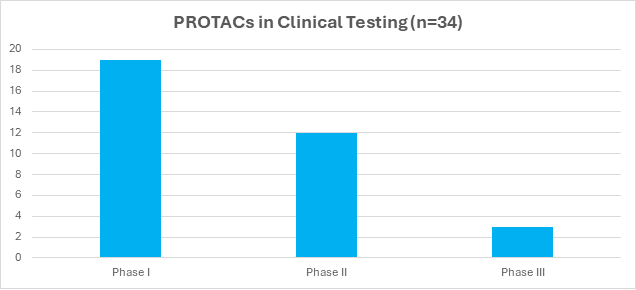
Just a few dozen PROTACs are presently in clinical testing, with three granted “Fast Track” or similar accelerated status by the FDA due to their potential to address areas of unmet need. These investigational treatments target a diverse array of proteins, including the androgen receptor (AR), estrogen receptor (ER), Bruton's tyrosine kinase (BTK), and interleukin-1 receptor-associated kinase 4 (IRAK4). As of May 2026, the FDA has approved the first PROTAC, vepdegestrant (Arvinas) (2).
How do PROTACs work?
PROTACs link a target protein to an E3 ubiquitin ligase, triggering the protein’s breakdown by the proteasome. A change in the clinical pharmacology mechanism—from occupancy-driven to event-driven mode of action—makes them a powerful tool for targeting previously "undruggable" proteins in diseases like cancer and neurodegeneration. Unlike traditional inhibitors, PROTACs work catalytically and can degrade several sites containing the target receptor moiety in an iterative fashion before being cleared by the body.
Why are PROTACs challenging to develop?
The development of PROTACs is challenged by their physicochemical complexity, including high molecular weight compared with traditional agonist or antagonist small molecules, poor aqueous and very pH dependent solubility, and limited membrane permeability; characteristics that place them well beyond Lipinski Rule of 5 chemical space (1). These properties complicate formulation and limit oral bioavailability, necessitating the application of advanced formulation strategies.
What formulation technologies can be applied to PROTACs?
Approaches such as amorphous solid dispersions, cyclodextrin inclusion complexes, lipid-based systems, and nanoparticle formulations have been employed to enhance solubility, stability, and systemic exposure (3–6,7). In parallel, early clinical development requires careful justification of dose selection, anticipated pharmacokinetic behavior, and consideration of safety factors in first-in-human studies due to this different mode of catalytic action. Successful translation of PROTACs into clinical candidates depends on a comprehensive understanding of their biopharmaceutical properties and the implementation of formulation strategies coupled with PBPK and PBBM modelling to address their unique challenges.
How can Quotient Sciences help in the development of PROTACs?
Partnering with a CRDMO that excels in formulating and testing complex therapies requiring advanced biopharmaceutics expertise is essential for successfully advancing PROTACs to the clinic. For over 35 years, Quotient Sciences has specialized in the development of challenging molecules, with a proven track record of developing and evaluating drugs that demand innovative solubility enhancement strategies. Find out how we can support your program.
What does the future hold for PROTACs?
Although only one PROTAC-based therapy has reached the market in 2026 so far (2), products from BeiOne Medicines (BeiGene) and BMS advancing into Phase III trials last year is a positive sign for the future of PROTAC drug development. As clinical experience with PROTACs expands, these insights will be critical to optimizing their therapeutic potential and broadening the scope of druggable targets in modern medicines.
References:
- Li, X., Pu, W., Zheng, Q., Ai, M., Chen, S., & Peng, Y. (2023). Proteolysis-targeting chimeras (PROTACs) in cancer therapy. Cell Communication and Signaling, 21, Article 231. https://doi.org/10.1186/s12964-023-01231-2
- https://www.globenewswire.com/news-release/2025/08/08/3130368/0/en/Arvinas-Announces-FDA-Acceptance-of-the-New-Drug-Application-for-Vepdegestrant-for-the-Treatment-of-ESR1m-ER-HER2-Advanced-Breast-Cancer.html
- Zhang, H., Wu, H., Wang, L., Machín Galarza, L., Wu, C., Li, M., et al. (2024). Preparation and characterization of ternary complexes to improve the solubility and dissolution performance of a proteolysis-targeting chimera drug. Journal of Inclusion Phenomena and Macrocyclic Chemistry. https://doi.org/10.1007/s10847-023-01214-0
- Pöstges, F., Kayser, K., Appelhaus, J., Monschke, M., Gütschow, M., Steinebach, C., et al. (2024). Solubility enhanced formulation approaches to overcome oral delivery obstacles of PROTACs. Pharmaceutics, 16(2), 231. https://doi.org/10.3390/pharmaceutics16020231
- Syahputra, E. W., Lee, H., Cho, H., Park, H. J., Park, K.-S., & Hwang, D. (2025). PROTAC Delivery Strategies for Overcoming Physicochemical Properties and Physiological Barriers in Targeted Protein Degradation. Pharmaceutics, 17(4), 501. https://doi.org/10.3390/pharmaceutics17040501
- Zhong, J., Zhao, R., Wang, Y., Su, Y., & Lan, X. (2024). Nano-PROTACs: state of the art and perspectives. Nanoscale, 16(9), 4378–4391. https://doi.org/10.1039/D3NR06059D
- Hofmann, N., Hoffmann, A., Keck, S., Langguth, P., & Schick, P. (2024). ASDs of PROTACs: Spray-dried solid dispersions as enabling formulations. International Journal of Pharmaceutics, 650, 123725. https://doi.org/10.1016/j.ijpharm.2023.123725