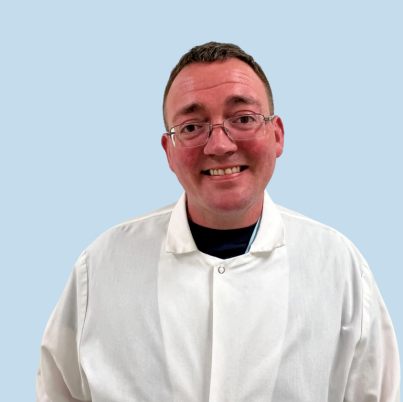
John Entwistle - Senior QC Scientist

John Entwistle

John Entwistle

Senior QC Scientist

Subject Expert
About

John Entwistle is a dynamic and driven scientist with extensive academic and career related experience in laboratory processes and analysis. He is a results-oriented with an emphasis on solving problems using a keen eye for detail. His laboratory experience includes many analytical chemistry technics.

John holds a degree in Cell Biology from Gwynedd Mercy University.

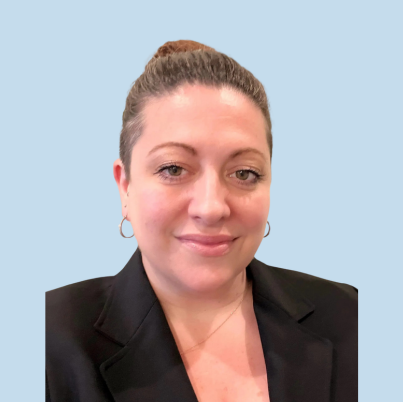
Nichole Caparelli - Senior Director, Quality Operations

Nichole Caparelli

Nichole Caparelli

Senior Director, Quality Operations

Subject Expert
About

Nichole Caparelli has over 20 years of experience in small molecule manufacturing from development through commercialization with proven track record of implementing and overseeing quality management systems and driving continuous improvement initiatives to enhance product/process quality and operational efficiency.  

She held positions of increasing responsibility at various CDMO pharmaceutical companies based in the US.  She has successfully led and facilitated regulatory authority inspections while ensuring quality management systems are in place, in use, and effectively monitored to facilitate compliance with CGMP requirements.  

Nichole is responsible for the Quality Systems, Project Quality Assurance, and Quality Control functions at the Philadelphia sites.

Nichole holds a degree in Chemistry from the Moravian University.

Unlocking True Partnerships: Going Beyond Science in Outsourcing Formulation Development & Manufacturing

News & Announcements

Unlocking True Partnerships: Going Beyond Science in Outsourcing Formulation Development & Manufacturing

Hexagons on blue gradient background

This article by Drug Development & Delivery highlights the importance of Contract Development and Manufacturing Organizations (CDMOs) for the pharma and biotech companies when it comes to advancing innovative therapies. 

In this annual report, lead­ing CDMOs speak with Drug Development & Delivery about how they are adapting to bio/pharma client needs. In addition, this report also discusses the integrated CDMO/CRO services offered by Quotient Sciences and how the company’s Translational Pharmaceutics® platform in­tegrates formulation development, on-de­mand and adaptive GMP manufacturing, healthy volunteer clinical testing, data analysis and full regulatory support within a single organization.

To read more, check out the full article here on the Drug Development & Delivery website.

Dale Mitchell - Senior Director, Small Molecule Drug Discovery at Charles River

Dale Mitchell

Dale Mitchell

Senior Director, Small Molecule Drug Discovery at Charles River

Guest Expert
About

Dale Mitchell is currently a Senior Director within small molecule drug discovery at Charles River. 

Dale has worked for Charles River and legacy companies since 2000 and has 35 years’ experience in the pharmaceutical and agrochemical industries. Dale has led a wide range of collaborative programs in areas such as inflammation, oncology, anti-infectives, neurodegeneration and PET imaging. 

In his current role, Dale provides strategic oversight on integrated drug discovery programs, working closely with multi-disciplinary project teams and partners to generate hit compounds, deliver lead series and identify pre-clinical candidates.

CMC Strategies to Manage the Risks Associated with Accelerated Submission Pathways

On-Demand Webinars , Regulatory Affairs , CMC , Orphan Rare Diseases , Pediatrics

CMC Strategies to Manage the Risks Associated with Accelerated Submission Pathways

30 May 2024
Overview

There has been a growing need for the development of new treatments to address rare diseases, which often have limited or even no viable treatment options available. Since the signing of the Orphan Drug Act into law in the United States in 1983, the US Food and Drug Administration (FDA) has given special consideration to companies, providing “Fast Track status,” awarding research grants, and providing other incentives when certain criteria are met. These offer advantages to streamline the development of new therapies to treat rare diseases, and similar standards also exist in the United Kingdom and the European Union. The acceleration of the clinical program reduces overall drug development timelines, which can bring CMC challenges along the way.

In this webinar, Dr. Asma Patel, Vice President of Integrated Development Services, delves into how global agencies have implemented accelerated regulatory pathways to develop novel therapies to treat serious diseases. Dr. Patel will discuss navigating the pathways for accelerated submission and exploring the regulatory framework as it relates to orphan drugs for rare diseases. She will discuss CMC strategies to manage the risks associated with accelerated submission pathways, up to and including the scale-up and commercial manufacturing of drug products.

You will learn how to identify creative development strategies for accelerated submission pathways, from early clinical studies through to commercial launch.


In partnership with:

One Nucleus

Watch Now
Date
30 May 2024

Introducing Translational Pharmaceutics: Asma Patel and John McDermott

Articles & Publications , Dr. Asma Patel , John McDermott

Introducing Translational Pharmaceutics: Asma Patel and John McDermott

Small Molecule Development & Manufacturting at Quotient Sciences

In this article by the Medicine Maker, Asma Patel and John McDermott talk about the complexities of developing modified release formulations.

These formulations allow more control over drug release in the gastrointestinal (GI) tract, providing benefits such as prolonged drug plasma levels, reduced dosing frequency, and targeted delivery. To optimize drug delivery, a “translational pharmaceutics” approach evaluates a “design space” within clinical studies, aligning with ICH Q8 quality-by-design principles.

Continue reading the article on Medicine Maker.

Colleague Stories: John Entewistle

Careers , Philadelphia , John Entwistle

Colleague Stories: John Entewistle

In this interview, John Entwistle, Analytical Scientist at our Philadelphia facility, shares a day in the life of his role. 

John Entwistle is the Analytical Scientist in the Quality Control Department at our Philadelphia facility, where he works on clinical phase projects, performing release and stability testing for the manufactured products. 

After about 4 years, I left Quotient Sciences for a role outside of the company but later decided to return for better work-life balance and because of the relationships with others that I valued.

-    John Entwistle

What does an Analytical Scientist do at Quotient Sciences?  

As an Analytical Scientist in the quality control department, my role is collaborative. I work on clinical phase projects, performing release and stability testing for the products manufactured at Quotient Sciences. I am part of a team of three analysts, where we review each other’s data and reports, ensuring our work is completed fully and in a timely manner. This collaborative environment is a key aspect of our team's success.  

Describe a typical day in the quality control department?  

All final products undergo four typical tests: appearance, water content, assay, related substances, and dissolution. Depending on the product type, a few more tests may be required for release.

An average day in my department really depends on the type of sample we are testing. When I test stability, it is easy to plan because I know when the Stability Coordinator will be pulling samples and which tests are required, so I can set up my testing schedule and plan my day easily. With a release sample, we are aware of the testing needs but need to be flexible about when the sample will be submitted to the lab.  

In a week, after I have my assigned samples, I usually spend the beginning of the week preparing the reagents and materials for all the tests. Then, I will start to perform testing based on the availability of equipment. The group has other responsibilities outside of testing the drug product, including review and report generation. We typically plan for those activities in between sample testing or after all the samples have been tested.

In your view, what makes Quotient Sciences unique?  

One of the most exciting aspects of my role is working on the delivery of Quotient Sciences’ Translational Pharmaceutics® programs. This innovative approach allows us to manufacture, test, and release drug products at Quotient Sciences - Philadelphia, which are then shipped to Quotient Sciences - Miami for dosing in our Phase I clinic. This unique offering enables us to conduct cGMP manufacturing and clinical research in a condensed timeframe, delivering results to the customer faster than traditional drug development methods. It's a thrilling opportunity to be part of such cutting-edge work.

When working with a Translational Pharmaceutics® sample, it is a very short turnaround time and we need to be extra prepared before the sample is ready to ensure we meet the timelines. We make sure everything from reagents and materials to instruments are all ready to go and prepared before the sample arrives for testing.      

How has your career progressed since joining us?  

I have been lucky here at Quotient Sciences to transition into roles in different groups and learn new skills and aspects of the business. I began my career in the cleaning validation, raw materials, and sampling group at Quotient Sciences’ Chelsea Parkway facility, before our Garnet Valley facility was planned to be built. In that role, I learned a lot about the manufacturing rooms and equipment, sampled raw materials to be tested, and released them to manufacturing to produce the drug products. From there, I moved into commercial quality control doing in-process testing and final product release and stability. There, I learned to test large volumes of samples, sometimes up to 60 dissolutions in one month! I then transitioned into analytical development where I was performing method development, method qualifications, and late-stage method validations.  

After about 4 years, I left Quotient Sciences for a role outside of the company but later decided to return for better work-life balance and because of the relationships with others that I valued. I re-joined the company and have been in my current role within the quality control department doing clinical phase work ever since. At this time, our Garnet Valley facility was built so I began working there. Our Garnet Valley and Chelsea Parkway facilities are only a little over a mile from each other so working between sites is very easy. If a project starts at one site, sometimes the client wants their product tested at that site. When this occurs, I end up switching sites to perform testing. What can be challenging with changing sites is securing instrumentation to do testing. Fortunately, with the LIM’s system and instrument manager being put in place, this challenge should be eliminated in the future.    

How do you collaborate with colleagues at our two Philadelphia sites, as well as with our UK and Miami facilities?

Both Philadelphia sites essentially started at Chelsea Parkway and then our Garnet Valley facility was built. The two sites basically function as one. As I mentioned, the two facilities are only about a mile away from each other. Most of the employees have functions at both sites so it is not unusual for people to be at both sites on the same day.

My collaboration with the United Kingdom facilities mostly involves new projects transferring to the United States. We work together to plan what steps need to be in place to successfully integrate the projects into our workflow.

Additionally, I work with both the UK and Miami sites on Translational Pharmaceutics® programs. Together, we work through a tight timeline to manufacture, test, release, and dose. We manufacture, test, and release drug products at Quotient Sciences - Philadelphia. These products are then shipped to Quotient Sciences - Miami for dosing in our Phase I clinic. This allows us to get results to customers in a shorter timeframe, a key benefit of out Translational Pharmaceutics® platform.

What experience did you have before working at Quotient Sciences, and what other learning opportunities have you had since joining?

For my role, a bachelor’s degree in chemistry or a science related field was required. I met this criteria, holding a BS in Biology. I had three years' experience in environmental, performing Ion Chromatography, HPLC, GC. I also had two years' experience in the medical device area testing similar instrumentation.

Through my role at the company, I have gained more knowledge in the development and implementation of Labware ELN. I was elected as one of the first people to use the system and provide feedback. Eventually, I became part of the power users’ team. In this team, we work through any issues that arise and make decisions on what we want the program to do for us and look like. With my help, there has been a successful role out of Labware ELN at the Philadelphia site.  

What do you enjoy most about your role, and what is the most challenging?

I like that I can work between groups to meet the goals of our company. Having experience in multiple groups has helped me embrace many ways of looking at the same situation and find creative ways to work through them. For example, I have knowledge of testing and release from raw materials to final product. Using that knowledge, I can deduce down the minimal time needed to deliver for a certain product.  

I would say that the most challenging part of my role is scheduling Translational Pharmaceutics® in with routine testing. Since the timelines for Translational Pharmaceutics® are so rigorous and short, it is important to be able to halt normal testing and focus on Translational Pharmaceutics®, then revert back

What’s the team like?  

The QC department is a great group of people, and working with them is my favorite part of the job. We always help each other out and work well together. We have in our Standard Operating Procedure (SOP) that all testing for stability must be started within 30 days of the pull date (date pulled from the stability chamber). If we start testing after the 30 days, the client must be contacted and a deviation is taken out by QA to explain why testing was not performed. If any testing gets close to being out of the testing limit, someone else on the team will help and pick up testing needs. This is just one example of how we collaborate and work well together to reach our project goals as a team.

What advice would you give to someone applying for a role in your team?  

I would say it is a great place to learn. There is a lot of knowledge across all functions, so my advice would be to take in as much information and knowledge as possible from collaborating with our teams.  

What do you like most about working at Quotient Sciences?  

Everyone works together and will always help you if you need something. We all have the same goal for our clients, and each person does whatever they can so customers and patients are getting the best product possible. We also have events to celebrate employee milestones, and there are often events happening on-site that help to build relationships with one another.  
Martin Wing-King - VP & General Manager - Reading, UK - Arcinova

Martin Wing-King

Martin Wing-King

VP & General Manager - Reading, UK - Arcinova

Subject Expert Facility Leader
About

Martin Wing-King joined Pharmaterials in 2008, a company later acquired by Quotient Sciences in 2017, and has held various business development, project management leadership, and operations leadership roles with the company for over 16 years. 

Martin holds a Bachelor of Science in Chemistry and Management from Brunel University London.

Expertise & focus areas

Harpreet Smith, MBA, MSN, RN - VP and General Manager, Quotient Sciences - Miami

Harpreet_Smith_headshot

Harpreet Smith, MBA, MSN, RN

VP and General Manager, Quotient Sciences - Miami

Subject Expert Facility Leader
About

Harpreet Smith has been with SeaView Research and Quotient Sciences - Miami since 1999, where she has held various leadership roles in the areas of operations and clinical pharmacology

Harpreet holds a Master of Science in Nursing with a focus on Clinical Research Management from Duke University, and an Executive MBA and Bachelor of Science in Nursing from Florida International University. 

Spotlight on Quality: Interview with Nichole Caparelli

Philadelphia , Quality Assurance , Nichole Caparelli

Spotlight on Quality: Interview with Nichole Caparelli

Quotient Sciences’ facilities in Garnet Valley and Boothwyn are located just outside of Philadelphia. 

Together, the facilities support small-molecule oral solid dose (OSD) formulation development and drug product manufacturing, with capabilities for small batches for Phase I/II trials through late-phase manufacturing and commercial product supply.

As part of recent site leadership appointments, Nichole Caparelli has joined the company as Sr. Director, Quality Operations. Ms. Caparelli has over two decades of experience in quality and operations roles with companies including Johnson Matthey, Veranova, and Flamma Group. Marlene Leuenberger has also recently joined as Vice President and General Manager of Quotient Sciences’ Philadelphia facilities.

In this interview, Nichole discusses her new role and enhancements at Quotient Sciences – Philadelphia that focus on quality.

Tell us about yourself and your background.

My career has been focused on small molecule manufacturing, including product development through commercialization. At past organizations, I have been responsible for implementing and overseeing quality management systems and driving continuous improvement initiatives that enhance overall product and process quality and operational efficiency. This involved successfully leading regulatory authority inspections and ensuring quality management systems are in place, in use, and effectively monitored to facilitate compliance with cGMP requirements. Most recently, I was a Quality Director at Flamma USA, leading the QA, QC and stability teams in the development and implementation of comprehensive quality management systems.

What initially got you interested in a career in Pharma?

My choice to pursue a career in pharmaceuticals was driven by my desire to make a tangible difference in people’s lives and my admiration for the complexity and innovation inherent in the industry.  I am eager to contribute my skills and knowledge to a field that holds such profound significance for global health.

What will your role focus on at Quotient Sciences – Philadelphia?

In my new role, I report into our global quality department and will be responsible specifically for the Quotient Sciences – Philadelphia sites. This involves leading the quality system, project quality assurance, and quality control functions at both of our Philadelphia facilities.

What developments are on the horizon this year to enhance quality and related systems or processes at Quotient Sciences – Philadelphia?

For 2024, we are focused on continuing to build Philadelphia's overall site quality culture. This will be done largely through continuous improvement and a focus on the people, processes, and systems for quality. I will be leading the site quality operations team to consistently achieve compliance targets and aid in transforming the site's approach to quality.  

Learn more about Quotient Science's facilities in Boothwyn, PA and Garnet Valley, PA.

Subscribe to